Thursday, August 16, 2007

Lexington and Concord

We arrived in the Boston area after a full day of travel, tired and a little anxious about where we'd stay. But no problem: we were greeted at the Family Camp at Hanscom AFB with "Sure we'll make room for you!" We stayed in an overflow area for a night then moved to a regular slot. (The park doesn't take reservations.)

We're only a short distance from the PX and commissary, and not too far from all the sights of the area.


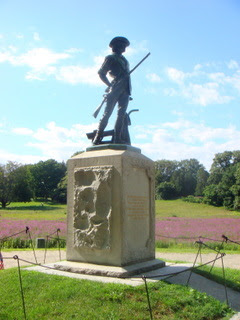
So, on Saturday 11 August we visited the National Historic Park at Lexington and Concord. They have a beautiful multimedia presentation of the battle in the visitors' center to start things off. This is the famous "Minuteman" statue, memorializing those farmers, shopowners and workers who promised to be ready within a minute, weapons in hand, should they be needed to defend their land. After the British met the militia on Lexington Green and someone fired "the shot heard 'round the world", the Redcoats shot into the crowd and killed and wounded several. The militiamen retreated, leaving the British to march on to Concord in search of the weapons hidden there. They found none, of course; early intel had allowed the rebels to move them to safer places.
The militia then met the Brits at this bridge and fired upon them, beginning the rout that chased them all the way back to Boston. For a great read, pick up David McCullough's 1776. It's terrific and fun reading!
Concord was also the home of later poets and authors, such as Hawthorne, Louisa Mae Alcott, Emerson and Thoreau. They founded the School of Philosophy next to Alcott's home, the beginnings of American Transcendentalism.
We don't know all the nuances of this philosophy/religion, but it pervaded the Congregational churches and there were splits, with the Unitarian churches developing, and later linking up with the Universalist movement. Today, many of these beautiful old parish churches carry a Unitarian-Universalist label.
They are not a Christian organization; in fact, they rarely use that label for themselves. Here's a link for more info if you're interested. I mention it only because so many of the old beautiful Christian churches in New England now carry this banner.
Tomorrow: Boston.

Saturday, August 11, 2007

Acadia National Park

We visited Acadia National Park on 7 and 9 August. On the coast of Maine and consisting of multiple islands, it is a wonder created by eons of glacial activity.


We climbed mountains trails and played with balanced rocks. And took pictures!


In all, they were two leisurely days of sightseeing in one of our country's premier parks.
The next day we leave for Boston.

Campobello and the Burnham Tavern

During the last century several wealthy families discovered a small Canadian island, Campobello, and turned it into their private retreat. One of these was the family into which our future president, Franklin D. Roosevelt, was born. He grew up spending his summers here and through him, his "beloved island" became known to many Americans. Today, Campobello is an international park, administered jointly by the USA and Canada, the only such park in existence. It is dedicated to the perpetual friendship between the two countries to which FDR was committed.

We first went to the far end of the island, Quoddy Point lighthouse, for some spectacular views and possible whale spottings.


The beach near the lighthouse, and our whale spotter in action.


The coastline of the island is gorgeous! We then took the 30-minute ferry to nearby Deer Island to see the "Old Sow", the hemisphere's largest whirlpool. If you're like we were, you never heard of it before now. But there it was on our map, so we went for it! This arial view gives a much better idea.

One of the main features of the island is the Roosevelt Cottage, now the park.


Here Theresa, one of the park hosts, gave us an informative tour of the cottage. Campobello is only a short drive across an international bridge, and requires only picture ID. It's well worth your time if you're ever in this part of Maine.
We left the next morning along US 1 on our way to Acadia National Park. We stopped momentarily in Machias, Maine for a look at the Burnham Tavern, possibly remembered by any history buffs as the site of the first naval battle of our Revolutionary War. In this tavern plans were laid for the battle. Click here for the very fascinating story.
Rog and Meg


Fundy National Park

While visiting this area we camped at Ponderosa Pines, a beautiful campground a mile from Hopewell Rocks Park and a short drive to Fundy National Park. So, the day after the Rocks, we visited the NP, which consists primarily of hiking and driving trails through some gorgeous country. The park was built to maintain wilderness area and several miles of coastline on the Bay of Fundy. The main take-home point of the Bay is that its tides rise and fall more than any others in the world, resulting in spectacular before-and-after pictures.
Here are pix of the port and ships when the tide is in and OUT:

We enjoyed the park and the exercise it afforded. Tomorrow we leave Canada and head for Maine!

Thursday, August 09, 2007

Hopewell Rocks!

On Wednesday 1 August we said our goodbyes to Ardyth and family and prepared to leave Nova Scotia. However, it still took us almost two hours to get out of the backyard. The gate was a narrow one and at an angle to the house, and neither of our vehicles could negotiate the turn. So, after considerable turning, backing, discussion and speculation, not to mention prayer, we finally got our "early start" close to noon!

We stopped a few miles down the road to visit Gaspereau Vineyards and Winery, the only one we've been to on our trip. It was a lovely tour with lots of explanation of the relatively new industry in Nova Scotia. After our picnic on their grounds, we drove to New Brunswick's Hopewell Rocks, a provincial park which boasts large surf-carved land masses in the Bay of Fundy, where the tides rise and fall over 40 feet twice daily. Their motto, "Where you can walk on the ocean floor!" attracts thousands annually to see this wonderful natural phenomenon. From the main level one descends to the ocean floor via this staircase. The Fundy coast lives by the tidetables and they're posted almost everywhere. You're allowed on the "beach" from 3 hours before until 3 hours after every low tide, a six-hour window twice daily. The rest of the time you watch the tide come in and fill up the area where you were walking only a short time before.


Some of the formations are lovely arches; others are the "Flower Pots" seen here, tall sandstone structures with flowers and trees "stuck" on top.


These lovely flowers grow on the edge of the cliffs, where we waited for high-tide, which dutifully returned right on schedule. The view from the foot of the descending staircase shown earlier: Our last view of Hopewell Rocks now at high tide, before returning to our campsite: Wish you were here!
Rog and Meg, Jon and Geri